


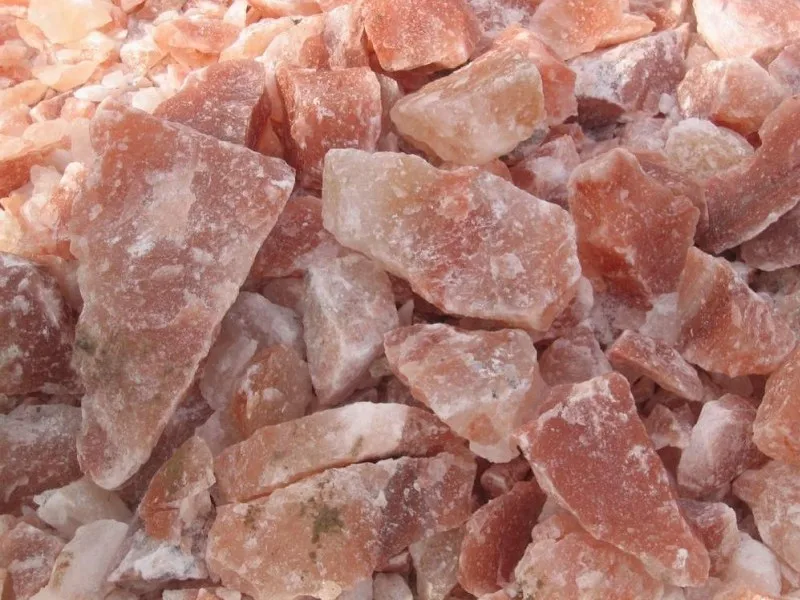
Inexhaustible reserves of rock salt from numerous localities are available in Pakistan. Extensive depositsof rock saltoccur in theSalt Range Formation (Prccambrian) and in Early Eocene Bahadur Khel Salt (Early Eocene). Besides these, the sea salt is also produced in coastal areas and lake salt deposits in Thar area. Production of rock salt in 1974 was 350,000 tonnes as compared to that of sea salt, which was 125,000 tonnes (Hundal and Gauhar, 1975). Since, sea salt is not a commodity related truly with geology, only rock salt deposits will be described here. The main Precambrian salt production comes from Billianwala Salt Marl Member (the lower member of Salt Range Formation). It is exposed along the southern escarpment of the Salt Range where salt mines are established at Kalabagh, Warchha and Khewra. There are several salt seams, some of them as much as 20 to 25 m or exceptionally up to 90 m thick. The seams are generally separated by beds of red marl. Thinner salt scams are also present in the upper member, viz., Sahiwal Marl member. Salt is white to pink in colour. Total reserves of salt present at the three localities are 85 million tonnes of
which only Khewra deposits carry 82 million tonnes(Asrarullah, 1962).
Malik, 2001, carried out detailed exploration of the mines of Khewra area and indicated the reserves as follows:

which only Khewra deposits carry 82 million tonnes(Asrarullah, 1962).
Malik, 2001, carried out detailed exploration of the mines of Khewra area and indicated the reserves as follows:
“Resource calculation has been based on the available survey data and geological information. It is the first time that salt resources of the entire leased area have been calculated. Total
resources are summarized here:
Eocene salt production is obtained from Bahadur Khel Salt quarried at Jatta, Bahadurkhel and Karak in Kohat area of the Upper Indus Basin. The formation exposes massive salt bed, which is up to 100 m thick and is overlain by gypsum, dolomite and clay of Jatta Gypsum. Base of the salt is nowhere exposed, at Bahadurkhel about 500 m of salt was penetrated by drilling without reaching the base (Rashid et el., 1965). Reserve estimates have not been made but undoubtedly the deposits are very large.

No comments:
Post a Comment